
Dental Implants vs. Partial Dentures: Which Option Is Right for You?
Missing teeth rarely come with a single obvious solution. Two of the most common options patients weigh against each other are dental implants and partial dentures, and for good reason: both restore function and appearance, but they work in very different ways and suit different situations.
Neither option is universally "better." The right choice depends on your oral health, the number of teeth you're replacing, your budget, and your long-term goals. This guide walks through exactly how the two compare, so you can have an informed conversation with your dentist rather than guessing.
What's the Core Difference?
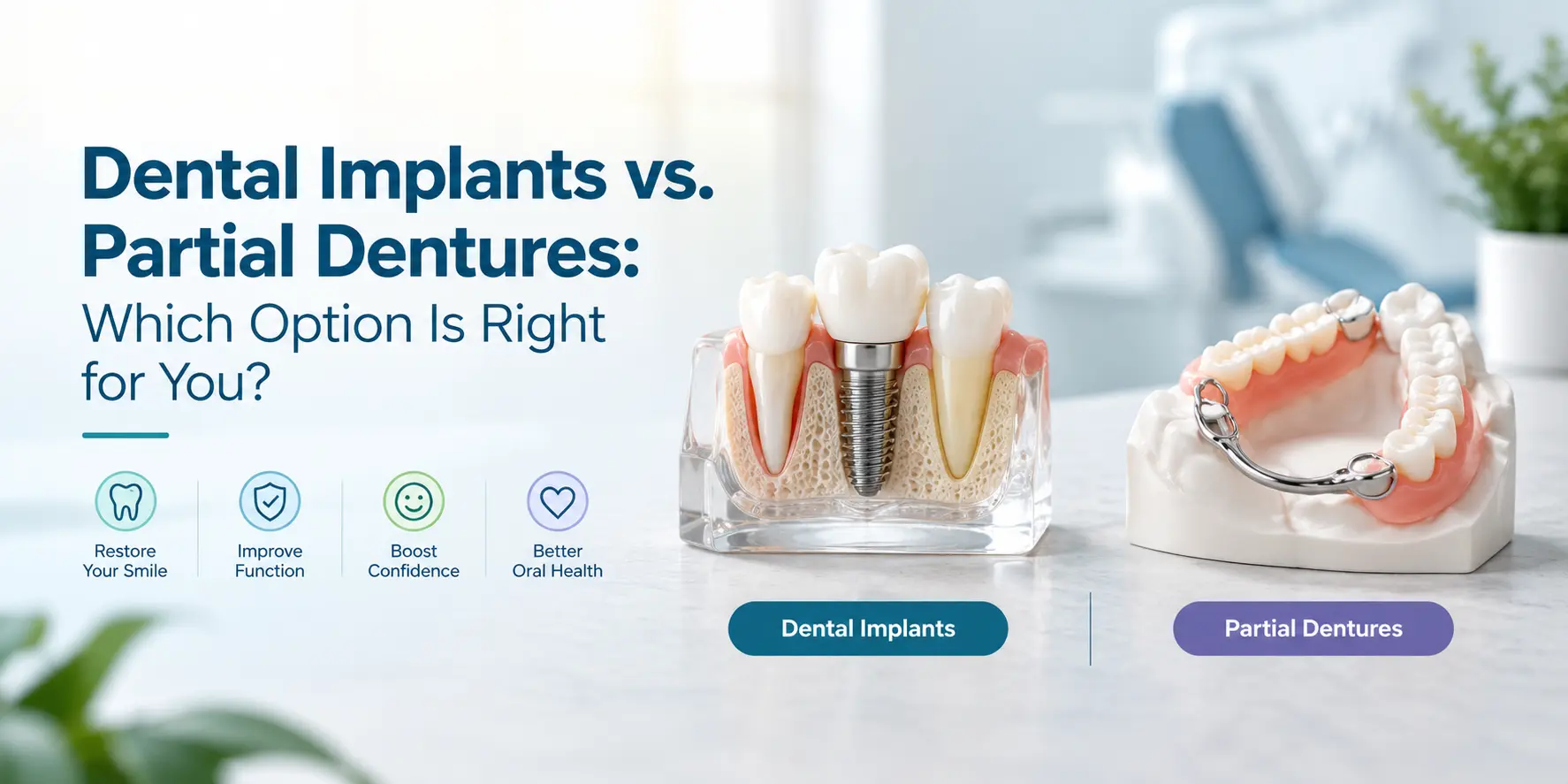
A partial denture is a removable appliance that replaces one or more missing teeth while working around your remaining natural teeth. It stays in place using a framework or clasps and can be taken out for cleaning and at night.
A dental implant is a fixed solution. A titanium post is surgically placed into the jawbone to act as an artificial tooth root, and a crown is attached on top. It functions and feels much closer to a natural tooth and isn't removed for cleaning.
That one difference, removable versus fixed, is what drives nearly every other distinction between the two.
Comparing Dental Implants and Partial Dentures
Factor | Dental Implants | Partial Dentures |
Stability | Fixed in the jawbone, no movement | Removable, relies on clasps for retention |
Feel | Closest to a natural tooth | Can feel bulkier, especially early on |
Procedure | Requires minor surgery | No surgery needed |
Treatment Time | Several months, including healing | Weeks, from impression to final fit |
Bone Health | Helps preserve jawbone by stimulating it | Does not prevent jawbone loss |
Maintenance | Brush and floss like natural teeth | Daily removal, cleaning, and soaking |
Longevity | Can last 20+ years, often a lifetime | Typically need replacement every 5 to 7 years |
Upfront Cost | Higher initial investment | Generally more affordable upfront |
Candidacy | Requires adequate jawbone density | Suitable for a wider range of patients |
When a Dental Implant Tends to Be the Better Fit
Dental implants are often recommended when:
- You want a permanent, fixed solution rather than something removable
- You're replacing a single tooth or a few teeth and want them to function independently of neighboring teeth
- You have enough healthy jawbone to support an implant, or are open to bone grafting if needed
- Preserving long-term bone structure in the jaw is a priority
- You're comfortable with a longer treatment timeline in exchange for a more permanent result
Because an implant integrates directly with the jawbone, it also helps prevent the bone loss that naturally occurs after a tooth is lost, something a partial denture cannot do.
When a Partial Denture Tends to Be the Better Fit
A partial denture is often the more practical choice when:
- You're replacing multiple teeth across different areas of the mouth
- You want a lower upfront cost or need a faster turnaround
- You'd prefer to avoid surgery
- Your remaining teeth and gums can support a removable appliance comfortably
- You want a solution that can be adjusted or modified later if more teeth are lost
Modern partial dentures, including flexible and cast metal designs, have also come a long way in comfort and appearance, so the gap between the two options is smaller than it once was for many patients.
Can You Combine the Two?
Yes. Some patients benefit from an implant-supported partial denture, which anchors the appliance to one or more implants instead of relying solely on clasps around natural teeth. This hybrid approach offers more stability than a traditional partial while avoiding the cost of placing a full set of individual implants. It's worth asking your dentist whether this middle-ground option fits your case.
Cost Considerations
Partial dentures typically cost less upfront than dental implants, largely because there's no surgical component involved. Dental implants carry a higher initial investment, but because they're built to last decades with proper care, many patients find the long-term value evens out compared to a partial denture that may need replacement or relining every several years.
Insurance coverage, the number of teeth being replaced, and whether any preparatory procedures (such as bone grafting or extractions) are needed will all affect your final cost with either option. A consultation and exam are the only reliable way to get an accurate price for your specific case.
How to Decide: Questions Worth Asking Your Dentist
- How many teeth am I replacing, and are they spread across the mouth or concentrated in one area?
- Do I have enough bone density to support an implant, or would I need grafting first?
- What's my timeline? Am I looking for the fastest fix, or am I comfortable with a multi-month process?
- What's realistic for my long-term budget, not just the upfront cost?
- Would a combination approach, like an implant-supported partial, make sense for me?
The Bottom Line
Dental implants and partial dentures both solve the same underlying problem, missing teeth, but they get there through very different approaches. Implants offer a fixed, long-term solution that helps preserve jawbone health, while partial dentures offer a more affordable, non-surgical way to restore function and appearance, especially when multiple teeth are involved.
The best way to know which is right for you is a thorough evaluation of your oral health, bone structure, and goals. At Elite Smile Family Dentistry, our team walks you through both options honestly, including the trade-offs, so you can make a decision you feel confident about.
Not sure which option fits your smile? Schedule a consultation with our Northville team today, or call us at 734-446-6440.
Frequently Asked Questions
Is a dental implant always better than a partial denture?
Not necessarily. Implants offer long-term durability and bone preservation, but partial dentures can be the more practical choice for certain patients, particularly those replacing multiple teeth or looking to avoid surgery.
Can I switch from a partial denture to implants later?
In many cases, yes. Patients often start with a partial denture and transition to implants later if their needs, budget, or priorities change, though this depends on individual bone health and oral conditions.
Do partial dentures damage the surrounding teeth?
When properly designed and maintained, partial dentures shouldn't damage neighboring teeth, though poor fit or inconsistent cleaning can contribute to issues over time, which is why regular checkups matter.
How do I know if I have enough bone for an implant?
Your dentist will typically take X-rays or a 3D scan during your consultation to evaluate bone density and determine if grafting is needed before implant placement.