
Porcelain Veneers vs. Cosmetic Bonding: Which Is Better for Your Smile?
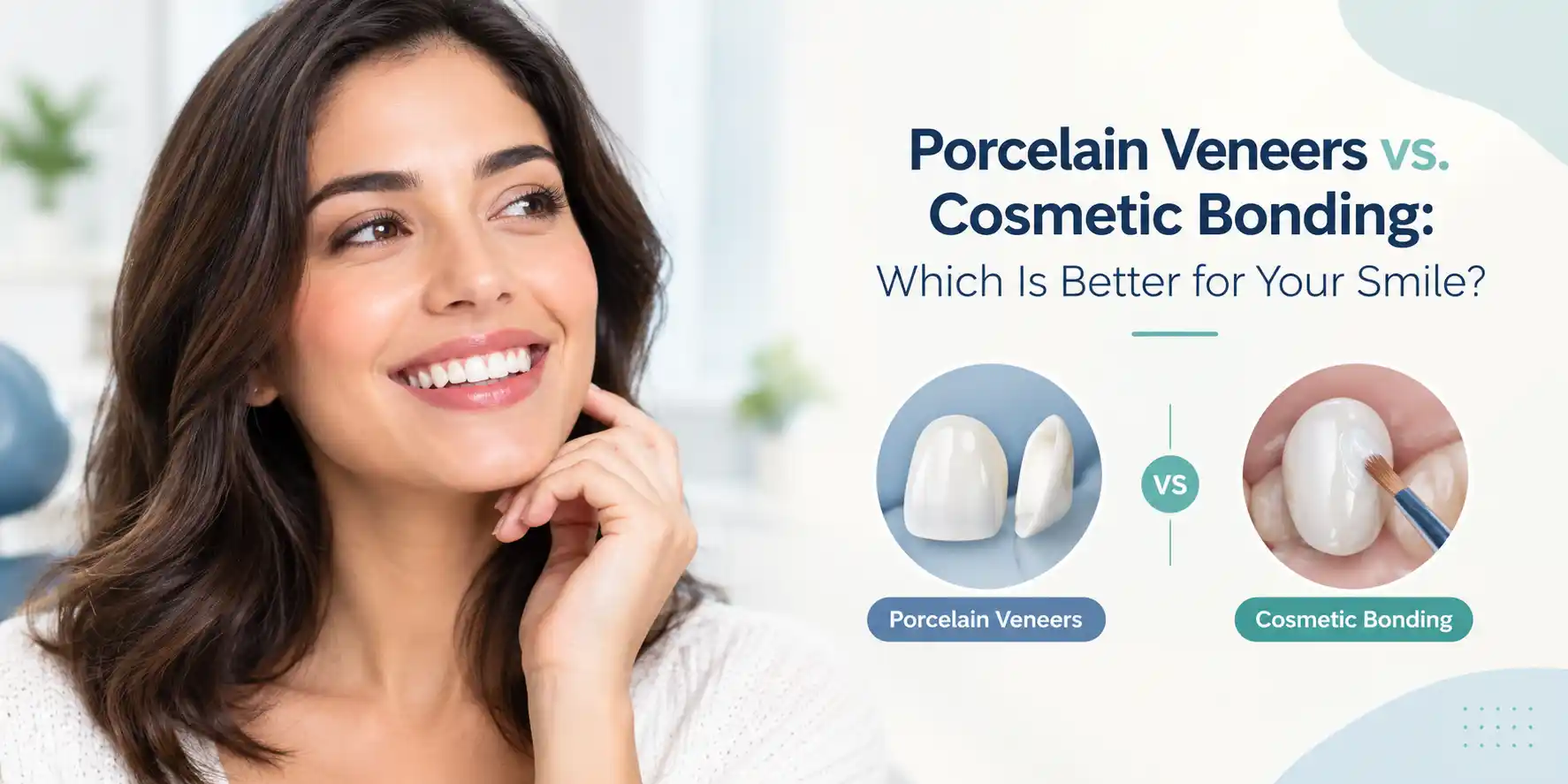
A chipped front tooth, a small gap, a stubborn stain, or an edge that looks uneven. These are some of the most common reasons patients ask about cosmetic dentistry, and two treatments come up again and again: porcelain veneers and cosmetic tooth bonding.
Both can improve how your teeth look. Both use tooth-colored materials. But they are built differently, last for different lengths of time, and suit different situations. The real question is not which one is better in general. It is which one is better for the problem you actually have.
This guide breaks the decision down by situation, so you can walk into a consultation knowing what to ask.
The Short Answer
- Choose bonding if the issue is small and localized, you want a faster and more affordable fix, and you prefer to preserve as much natural tooth as possible.
- Choose porcelain veneers if you want a longer-lasting, stain-resistant result, are changing the look of several teeth, or are correcting something bonding can't handle well, like deeper discoloration or noticeable shape and size changes.
Now let's look at why.
What Is Cosmetic Bonding?
Cosmetic bonding uses a tooth-colored composite resin that your dentist applies directly to the tooth, shapes by hand, and hardens with a special light. Because the material is built up on the tooth itself, it is usually an additive treatment, and in many cases little to no enamel needs to be removed.
Bonding is commonly used to repair small chips, close minor gaps, reshape slightly uneven edges, and cover localized stains or discoloration.
What Are Porcelain Veneers?
Porcelain veneers are thin, custom-made shells that are bonded to the front surface of the tooth. Unlike bonding, they are fabricated outside the mouth, based on impressions or digital scans, and then permanently attached. Preparing the tooth for a veneer typically involves removing a small amount of enamel so the veneer sits naturally and doesn't look bulky.
Because porcelain is a ceramic material, it closely mimics the way natural enamel reflects light, and it resists staining better than composite resin.
Porcelain Veneers vs. Bonding at a Glance
Factor | Cosmetic Bonding | Porcelain Veneers |
Material | Composite resin | Porcelain (ceramic) |
How it's made | Built and sculpted directly on the tooth | Custom-made, then bonded to the tooth |
Enamel removal | Often minimal to none | Small amount typically removed |
Reversibility | Often reversible or easily modified | Considered permanen |
Stain resistance | More prone to staining over time | Highly stain resistant |
Typical lifespan | Roughly 3 to 10 years | Roughly 10 to 15 years or more |
Repair | Often simple to repair or touch up | Usually replaced if damaged |
Upfront cost | Lower | Higher |
Best for | Minor, localized improvements | Larger or more comprehensive changes |
Lifespan and cost vary with your habits, bite, oral hygiene, and the extent of the work, so treat these as general ranges rather than guarantees.
Which Is Better for Your Situation?
This is where the decision usually becomes clear.
A Small Chip or Crack in One Tooth
Bonding is often the better first choice. It can restore the shape of a chipped edge in a single, relatively short visit, and it preserves natural tooth structure. If the chip is large or the tooth is structurally weakened, your dentist may recommend a veneer or crown instead.
A Minor Gap Between Teeth
Bonding can work well for small gaps, since the dentist adds material to widen the neighboring teeth slightly. For larger gaps or gaps across several teeth, veneers or orthodontic treatment may give a more balanced result.
Deep or Stubborn Stains
Veneers are generally the stronger option. Bonding material can pick up stains over time from coffee, tea, red wine, or tobacco, while porcelain resists them. If surface staining is the only concern, teeth whitening may be worth considering first. Our guide on veneers vs. teeth whitening explains how to decide.
Worn, Short, or Uneven Teeth
It depends on how many teeth are involved. For one or two teeth, bonding can rebuild length and shape. When wear affects many front teeth, veneers tend to give a more uniform and durable result.
Misshapen or Differently Sized Teeth
Veneers usually offer more control and consistency, especially when you want several teeth to look harmonious in color, shape, and proportion.
A Full Smile Makeover
Veneers are typically the better fit. Designing a set of veneers allows your dentist to plan color, shape, and symmetry across the whole smile.
Durability and Staining: What to Expect Over Time
Composite resin used in bonding is strong, but it is not as hard or as stain resistant as porcelain. Over the years it can wear down, chip, or darken slightly, especially with habits like coffee, tea, smoking, or nail biting.
Porcelain veneers are more resilient and hold their color well, but they are not indestructible. Habits like grinding your teeth, biting hard objects, or using your teeth as tools can chip or crack them. If you grind your teeth at night, mention it to your dentist, since a custom night guard may be recommended to protect your work.
Repairs: A Practical Difference Many Patients Overlook
Bonding is generally easier to repair. If a bonded edge chips, your dentist can often add or reshape material in a short visit.
A damaged porcelain veneer, on the other hand, often needs to be replaced rather than patched, although a very minor chip can sometimes be polished or repaired. That's a point in favor of veneers when it comes to long-term strength, and a point in favor of bonding when it comes to convenience and flexibility.
Cost: Think in Terms of Value, Not Just Price
Bonding generally costs less per tooth than porcelain veneers, which is a major reason many patients choose it for smaller concerns. Veneers carry a higher upfront cost because they involve custom fabrication and more materials.
Nationally reported figures give a useful starting point:
Treatment | Commonly Reported Range (Per Tooth, U.S.) |
Cosmetic bonding | About $100 to $600 for standard repairs, with larger full-surface work costing more |
Porcelain veneers | About $900 to $2,500 |
These are national ranges, not quotes. What you actually pay depends on your location, the dentist's experience, how many teeth you're treating, and how complex your case is. Because veneers cost more upfront but are designed to last longer, it helps to compare the cost over time and not just the day-one price.
When comparing, it also helps to think about:
- How many teeth you're treating
- How long you expect the result to last and whether you may need replacement or touch-ups
- Your goals, since a small repair and a smile redesign are very different projects
- Insurance, which often treats purely cosmetic work differently from repairs that restore function
The most accurate way to understand your costs is an in-person consultation. You can also read our detailed bonding cost and procedure guide for more background.
Can You Combine Bonding and Veneers?
Yes. Many treatment plans use both. For example, a dentist might place veneers on the most visible front teeth and use bonding to address a small chip on a neighboring tooth. Others use bonding as a more affordable starting point and move to veneers later if they want a more durable or dramatic result.
Questions to Ask Your Dentist Before You Decide
- Is my concern small and localized, or does it affect several teeth?
- How much natural enamel will be preserved with each option?
- How long can I realistically expect each option to last in my case?
- What does repair or replacement look like down the road?
- Do I grind my teeth, and does that change which option you'd recommend?
- Would whitening or orthodontic treatment improve the outcome first?
Conclusion
Cosmetic bonding and porcelain veneers are both effective, and neither is automatically the right answer. Bonding tends to win on speed, affordability, and preserving natural tooth structure. Veneers tend to win on longevity, stain resistance, and the ability to transform the look of a smile.
The best choice comes down to what you want to change, how many teeth are involved, and how long you want the result to last. A personalized evaluation is the most reliable way to find out, and a good dentist will explain the trade-offs honestly rather than steering you toward a single option.
At Elite Smile Family Dentistry, our Northville team walks through both options with you, so you can choose with confidence.
Not sure whether bonding or veneers is right for your smile? Schedule a consultation with our Northville team today, or call us at 734-446-6440.
Frequently Asked Questions
Is bonding or veneers better for a chipped tooth?
For a small chip, bonding is often the first option because it's quick and preserves tooth structure. For a larger chip or a weakened tooth, a veneer or crown may be recommended.
Which lasts longer, bonding or veneers?
Porcelain veneers generally last longer than bonding, often 10 to 15 years or more compared to roughly 3 to 10 years for bonding, depending on care and habits.
Does bonding stain more than veneers?
Yes. Composite resin is more prone to staining than porcelain, which is why veneers are often preferred when long-term color stability matters.
Can bonding be removed or changed later?
Bonding is often reversible or easy to modify because little or no enamel is removed. Veneers are considered permanent because a small amount of enamel is typically removed during preparation.
Is bonding cheaper than veneers?
Typically, yes. Nationally, bonding commonly runs about $100 to $600 per tooth for standard repairs, compared with roughly $900 to $2,500 per tooth for porcelain veneers. Your total depends on how many teeth are treated and the complexity of your case.
Can I get both bonding and veneers?
Yes. Some treatment plans combine the two, using veneers on the most visible teeth and bonding for smaller touch-ups elsewhere.