
Signs of Teeth Grinding at Night (And What a Custom Night Guard Actually Does)
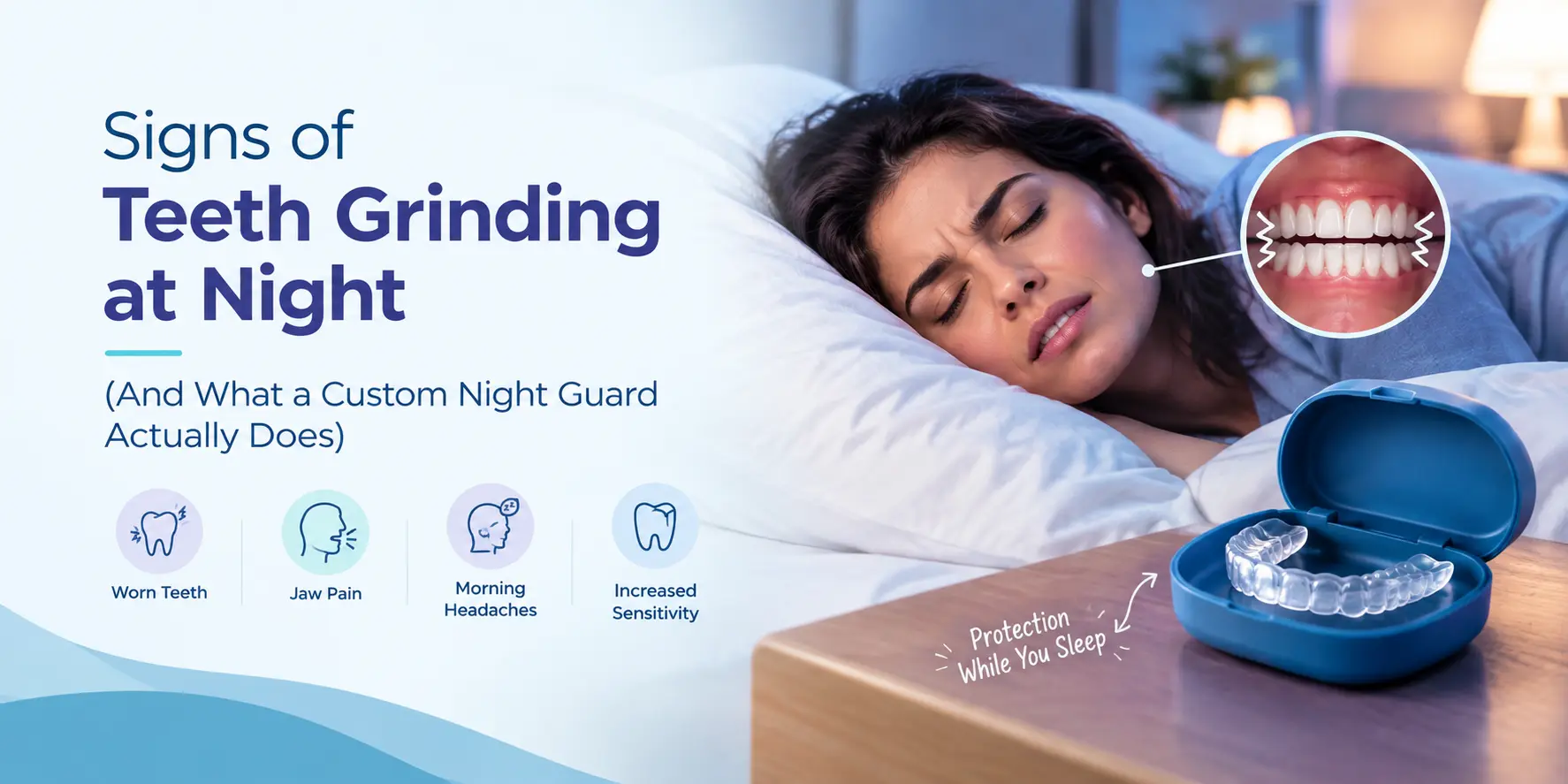
You wake up and your jaw aches. Not sharp pain. Just a tired, overworked soreness, like you spent the night chewing something that fought back. By mid-morning it fades, so you forget about it. Until it happens again next week.
Morning jaw soreness is one of the most common signs of teeth grinding at night, and it's also the easiest thing in the world to ignore. Grinding happens while you're unconscious, which means the damage builds for years before anything hurts enough to make you call a dentist. By the time it does hurt, you're usually not looking at a night guard anymore. You're looking at a crown.
So here's what to watch for, what grinding actually does to teeth, and what a custom night guard fixes.
Common Signs of Teeth Grinding at Night
The most common signs of teeth grinding at night are jaw soreness or stiffness when you wake up, dull headaches around your temples in the morning, teeth that have become sensitive to cold, flattened or chipped edges on your front teeth, and a partner who hears grinding sounds during the night. Most people notice two or three of these before they connect them.
Beyond that shortlist, a few quieter signals show up:
- Teeth that look shorter than they used to. Compare an old photo. The edges of your front teeth should have subtle bumps and variation, not a flat horizontal line.
- Gums that have pulled back. Gum recession, particularly around premolars and molars
- Fillings or crowns that keep coming loose or cracking for no obvious reason.
- Earaches with a clean bill of health from your doctor. The jaw joint sits directly in front of the ear canal, so joint strain often gets mistaken for an ear problem.
- Tightness when you first open your mouth wide in the morning, or a click when you yawn.
Why You Can't Feel It Happening
During sleep, your body suppresses the protective reflexes that normally stop you from biting too hard. Awake, your jaw muscles have a built-in brake. Asleep, that brake is off, and the muscles can generate force well beyond what normal chewing requires. It isn't a single hard bite either. It's repeated episodes across hours, night after night.
Which is why grinding wears teeth in a way that eating never does.
Daytime Clenching Counts Too
Grinding has a waking version, and it's quieter. Clenching while you're stuck in traffic on Seven Mile, or while you're staring down a deadline, loads the same teeth with the same force. You just don't hear it.
Daytime clenchers usually grind at night as well. If you catch your teeth touching while you read this sentence, that's the habit. Teeth should only meet when you swallow or chew.
What Teeth Grinding Does to Your Teeth Over Time
Enamel is the hardest tissue in your body, and it doesn't regenerate. Once it's gone, it's gone.
Enamel Wear and Sensitivity
Grinding removes enamel slowly. First the biting surfaces flatten. Then the thinner enamel at the edges of the front teeth starts to chip, giving them that translucent, slightly ragged look. As enamel thins, the softer dentin underneath is exposed, and dentin contains microscopic tubules that run straight to the nerve.
That's your cold sensitivity. It's not a coincidence that it showed up around the same time your jaw started aching.
Cracks, Chips, and Broken Dental Work
This is the expensive kind of damage. Sustained pressure creates hairline fractures inside the tooth that spread with every clench. A tooth can crack without any visible break and without hurting, until one day you bite into something and get a jolt of pain that comes and goes. If you've been getting those, read through the warning signs of a cracked tooth before it splits further. A cracked tooth caught early is often a crown. Caught late, it's often an extraction.
Grinders also lose chunks of tooth outright. Most of the chipped teeth we treat in Northville aren't from accidents. They're from a weakened edge that finally gave way on a piece of bread.
And grinding doesn't spare dental work. Crowns, veneers, and bonding are all strong, but they're bonded to natural tooth structure that's being stressed underneath. Patients who invested in porcelain veneers and then skipped the night guard tend to be back sooner than they expected.
How Do I Know If I Grind My Teeth in My Sleep?
Three checks, and the third is the one that settles it.
Ask Whoever Sleeps Near You
Sleep bruxism can be loud. A partner will usually have heard it long before you suspected anything, and they'll often remember roughly when it started, which is useful information.
Check Your Teeth in the Mirror
In the morning, under good light, look at the edges of your front four teeth. Flat, even wear across several teeth at once points to grinding rather than a single-tooth issue. Then check the inside of your cheeks and the edges of your tongue for the marks described earlier.
Get a Dental Exam
Wear patterns are obvious to someone who looks at teeth all day, and they're specific enough to show which direction you grind and how hard. We also check the jaw joint for tenderness and clicking, feel the muscles along the side of your face, and look for the cheek and tongue markings clenching leaves behind.
You'll get a straight answer in one visit. It's one more reason regular dental exams matter even when nothing hurts.
What a Custom Night Guard Actually Does
A night guard is a thin, custom-fitted shell that covers your upper or lower teeth while you sleep. It absorbs and spreads the force of grinding so your enamel takes none of it, and it lets the jaw muscles settle into a more relaxed position.
That's the whole job. It's armor, not medicine. A guard protects your teeth from grinding, and many patients also find their morning headaches and jaw soreness ease within a few weeks, because the muscles aren't working against a locked bite all night.
How the Guard Is Made and Fitted
We take an impression or digital scan of your actual bite, and a lab builds the guard to match it. Because it's made from your anatomy, it snaps into place and stays there instead of shifting or dropping out at 3am.
Two short visits. Scan or impression at the first, then a fit check and adjustment when the guard comes back, usually within two weeks. You can see the full range of dental appliances we make in Northville, including custom sports mouthguards for kids and adults.
Hard, Soft, or Dual-Layer
Material matters more than most people expect. Heavy grinders usually need hard acrylic, because soft rubbery material gives the jaw something satisfying to chew on and can leave the muscles more sore, not less. Lighter clenchers often do well with a dual-layer guard, soft against the teeth and hard on the outside.
We pick based on your wear pattern, not on a default.
Custom Night Guard vs. Store-Bought: Is the Difference Real?
Yes, but the honest version is more specific than "custom is better."
A boil-and-bite guard from the pharmacy costs about twenty dollars and will physically separate your teeth. If you're a light, occasional clencher and you need something this week, it beats nothing.
The problems show up with regular use. The material is bulky, which makes it uncomfortable enough that most people quit wearing it inside a month, and a guard in a drawer protects nothing. The fit is approximate, so it shifts and often falls out partway through the night. It wears through in a few months.
And here's the risk nobody mentions on the packaging: a guard that only contacts some of your teeth can let the uncovered ones drift, which changes how your bite comes together over time.
A custom guard costs more up front. It's thinner, it doesn't move, it lasts years instead of months, and it contacts every tooth in even balance. For anyone grinding hard enough to have symptoms, it's the cheaper option measured across three years, and much cheaper measured against a single crown.
Caring for Your Night Guard So It Lasts
Rinse it with cool water when you take it out. Brush it with a soft toothbrush and mild soap rather than toothpaste, which is abrasive enough to scratch the surface and dull it over time. Let it dry fully before it goes in the case, because a damp guard in a closed case grows bacteria.
Never leave it in hot water or in a car in July. Heat warps the fit permanently, and a warped guard is a replacement, not a repair.
Bring it along to your cleaning appointments and we'll check it for thin spots and wear.
When a Night Guard Isn't the Whole Answer
A guard handles the damage. It doesn't handle the cause, and sometimes the cause needs attention too.
Sleep-Disordered Breathing
Sleep bruxism is frequently linked to sleep-disordered breathing, including sleep apnea. If you snore heavily, wake up gasping, or feel exhausted after a full night's sleep, mention it. Treating the breathing issue can reduce the grinding itself. That's a conversation for a physician or sleep specialist, and we'll point you in the right direction.
Stress, Caffeine, and Medication
Stress shows up in bite force. So do caffeine late in the day, alcohol before bed, and certain medications, including some antidepressants. If your grinding started around the same time as a new prescription, that's worth raising with the doctor who wrote it.
Bite Alignment
If your teeth don't meet evenly, the jaw hunts for a comfortable position it can't find. Sometimes that calls for adjusting a high spot. Sometimes it calls for orthodontic treatment with clear aligners to correct the alignment properly.
Conclusion: Protect Your Teeth Before the Damage Adds Up
Nobody schedules a dental visit over a slightly stiff jaw. That's exactly the problem with grinding, because the window where a night guard prevents everything is the same window where it barely bothers you. Ten years of unprotected grinding turns into worn, sensitive, cracked teeth and a treatment plan with several zeroes in it.
The fix is unglamorous and it works. A thin piece of custom acrylic, worn while you sleep, and the force goes into the guard instead of your enamel.
If anything on this page sounded familiar, come in and let us look. Dr. Tosha Patel will tell you whether you're grinding, how far it's gone, and whether you need a guard now or just monitoring. If you do need one, we'll scan, fit, and have it protecting your teeth within two weeks.
Elite Smile Family Dentistry 17043 Ridge Road, Township of Northville, MI 48168 Call 734-446-6440 or request an appointment online.
Frequently Asked Questions About Teeth Grinding and Night Guards
Does a night guard stop teeth grinding?
No. A night guard protects your teeth from the damage grinding causes, but it doesn't switch off the muscle activity behind it. Any product claiming to cure bruxism is overselling. Protection of the teeth is immediate and total; symptom relief is common but varies, and usually takes a couple of weeks of consistent wear.
How long does a custom night guard last?
Most last between one and five years. That range is wide because it's set almost entirely by how hard you grind. Heavy grinders chew through hard acrylic in a year or two. Light clenchers often reach five. Replace it when you see perforation or thin spots, when the fit goes loose, or when symptoms return after a stretch of relief.
Does dental insurance cover a night guard?
Often, partially. Many dental plans cover occlusal guards when they're prescribed for bruxism, usually at a percentage of the cost and with a limit of one guard every three to five years. Medical plans occasionally cover it when grinding is tied to a diagnosed sleep disorder. Coverage varies enough that guessing is pointless, so we verify your benefits before you commit. See which plans we work with on our insurance page, or ask about our in-house care plan if you're uninsured.
Should a night guard go on the upper or lower teeth?
Upper, for most people. It's more stable and covers more surface area. We'll go with a lower guard if you have a strong gag reflex, if you sleep on your stomach, or if existing dental work on the upper arch makes it impractical. Either one protects both arches, since grinding needs two surfaces to happen.
Can I wear a night guard with braces, veneers, or implants?
Not over fixed braces, since the guard can't seat against brackets. If you're in clear aligner treatment, the aligners already separate your teeth overnight, and we'll fit a guard once treatment finishes. If you have veneers, crowns, or implants, a guard is strongly recommended rather than optional, because grinding is one of the fastest ways to shorten the life of that work.
Can teeth grinding be cured?
Not reliably, no. Bruxism is driven by a mix of sleep, stress, airway, and bite factors, and the honest goal is to control it and protect the teeth rather than eliminate it. Plenty of people grind for decades with no damage at all, because they wear a guard.
Is teeth grinding in children something to worry about?
Usually not. Grinding is common in kids, particularly while baby teeth are being lost and adult teeth are coming in, and most children grow out of it without treatment. We keep an eye on wear at checkups and only recommend an appliance if the wear is progressing or your child is waking with pain.